
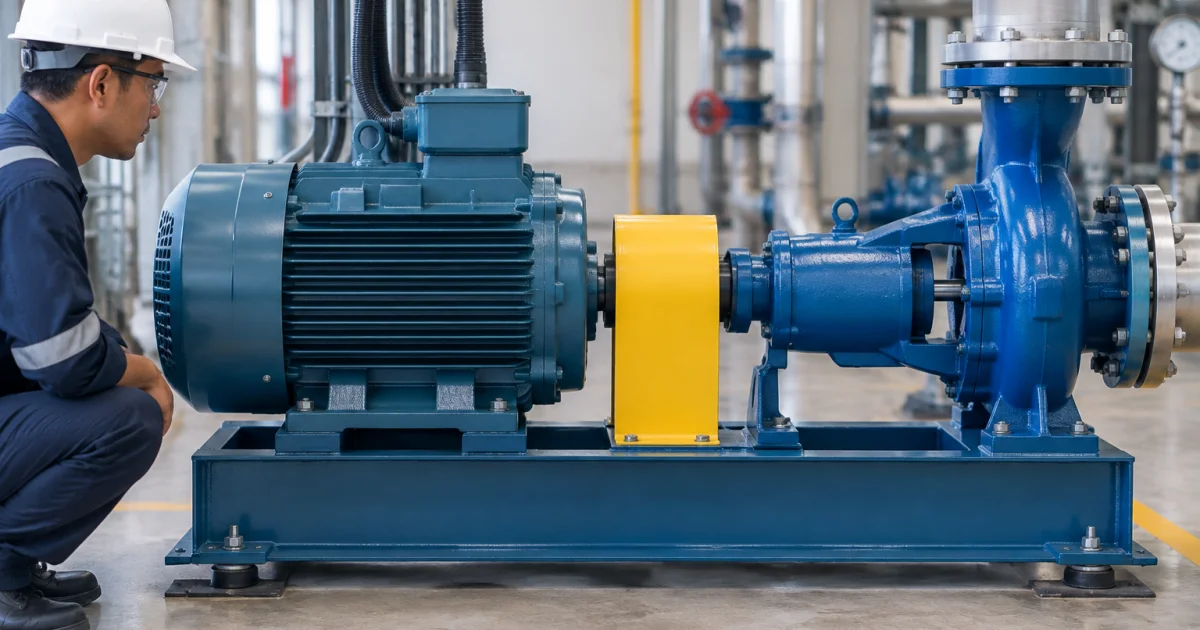
When a pump underperforms, trips, or runs hot, the motor is often blamed first. In practice, many failures come from a poor motor-to-pump match: insufficient power margin, wrong speed/pole count, unsuitable enclosure/IP for the environment, or controls/protection that don’t fit the load profile.
This tutorial is for maintenance teams, M&E contractors, and building operators who need to replace or specify an Electric Motor Malaysia buyers can match confidently to pump duty. Use the steps below to size from duty, confirm speed compatibility, pick a practical efficiency level, and specify protection suited to Malaysian conditions.
Step 1: Confirm what you are actually driving (pump type and duty)
Start with the pump and the duty point you must achieve. Motor selection depends on the pump curve and system curve—not only the old motor rating.
- Pump type: end suction centrifugal, multistage booster, submersible, self-priming, vertical inline, axial flow, etc.
- Liquid/service: clean water, hot water, wastewater, slurry, chemicals (affects torque, sealing, and starting method).
- Duty point: target flow (Q) and total dynamic head (TDH). Use the pump curve if available; otherwise record operating readings.
- Operating pattern: continuous, intermittent, frequent start/stop, pressure or level control, emergency-only.
- Environment: hot plant rooms, outdoor rain, corrosive air, flood risk, dust, washdown.
Practical check: for an end suction centrifugal pump, confirm whether the impeller was trimmed or the system has changed (new piping, extra floors, clogged strainers). The same pump model can draw very different power after these changes.
Step 2: Size the motor from pump duty (not from the old motor)
Base sizing on the required shaft power at the duty point. Many pump curves show power (kW) across flow—use that value at your operating point whenever possible.
2.1 Calculate or estimate required shaft power
If you don’t have curve data, estimate as a site sanity-check:
- Hydraulic power rises with flow × head.
- Shaft power is hydraulic power divided by pump efficiency (plus any drivetrain losses).
Because efficiency changes with operating point, the most reliable approach is still to obtain the pump curve or manufacturer duty/efficiency, then confirm impeller diameter and speed for the installed pump.
2.2 Avoid the most common sizing mistakes
- Undersizing: high amps, overheating, and trips—often worse in hot rooms or during peak demand.
- Oversizing: poorer part-load efficiency/power factor and less sensitive overload protection if settings aren’t corrected.
- Ignoring ambient/service factor: a motor that looks adequate on paper may fail in poorly ventilated Malaysian pump rooms.
Apply a sensible margin above expected shaft power to cover real conditions (dirty strainers, voltage variation, moderate system changes). The right margin depends on how stable the duty is and the consequences of a trip. With VFD control, consider the full operating envelope rather than one fixed point.
2.3 Match motor torque and starting method to the pump
Centrifugal pumps typically have modest starting torque needs, but starting current can stress building supplies and generators. Choose a method that the pump can accelerate with:
- DOL: simplest, highest inrush; common for smaller motors/strong supplies.
- Star-delta: reduced starting current/torque; confirm the pump won’t stall during acceleration.
- Soft starter: smoother starts, less mechanical shock; helpful for water hammer concerns.
- VFD/inverter: best for variable flow/pressure and optimisation; requires inverter-duty considerations (insulation, bearing effects, cooling at low speed).
If the pump starts against a closed valve or high static head, verify that reduced-voltage starting still provides enough accelerating torque.
Step 3: Choose speed, poles, and compatibility with the pump curve
On Malaysia’s 50 Hz supply, common induction motor choices are 2-pole (higher speed) and 4-pole (lower speed). Speed strongly affects centrifugal pump performance: flow changes roughly with speed, and head roughly with speed squared—so small speed changes can cause large duty and power changes.
- Replace like-for-like: keep the same pole count unless you have pump curves and a clear re-rating plan.
- Avoid “same kW, different rpm” swaps: fitting a 2-pole where a 4-pole was intended can overload the motor and raise cavitation/seal risks.
- Confirm rotation: after wiring changes, check direction before running under load.
For variable speed upgrades, treat pump and motor as one system: confirm minimum speed for cooling/stable control, maximum speed for mechanical/NPSH limits, and sensor location (discharge header vs remote point) for stable pressure control.
Step 4: Select efficiency and the right motor construction for real operating conditions
Efficiency reduces energy cost and heat. Lower heat typically improves bearing and winding life, especially in continuous-duty pump rooms.
4.1 Efficiency class and operating profile
Higher-efficiency motors are often most worthwhile for pumps that run many hours (booster sets, circulation, process cooling). For standby/intermittent duties, correct protection and construction may matter more than marginal efficiency gains.
Also consider part-load operation. If the pump is usually throttled or lightly loaded, a VFD and control redesign may deliver bigger savings than an efficiency upgrade alone—while still requiring correct sizing and speed selection.
4.2 Enclosure, cooling, and ingress protection
- TEFC: a common choice for pump rooms/outdoor use; better resistance to dust and moisture than open designs.
- IP rating: match the site (rain splash, washdown, dusty areas).
- Ambient/ventilation: cramped rooms can exceed typical rating assumptions—ensure airflow and keep fan covers clear.
For inverter-driven applications, confirm VFD suitability (insulation system and cooling at low speeds; external fans may be needed depending on duty).
4.3 Mechanical fit: frame size, mounting, coupling, and alignment
Installation details can cause premature failures even with perfect electrical sizing. Confirm:
- Frame/shaft details: shaft diameter, keyway, and shaft height match the coupling/pulley.
- Mounting: foot, flange, or foot+flange matches baseplate and guards.
- Alignment/soft foot: misalignment drives vibration and damages bearings/seals; align properly and re-check after tightening.
If vibration persists, inspect the pump (impeller condition, bearings, cavitation) instead of repeatedly changing motors.
Step 5: Specify protection, control, and wiring for pump reliability
Many pump-motor issues come from incorrect protection settings or missing safeguards. Good coordination reduces nuisance trips and prevents winding damage.
5.1 Electrical protections to consider
- Overload relay: set to the motor’s FLA and the application; incorrect settings either trip unnecessarily or fail to protect.
- Short-circuit protection: coordinate breaker/fuse with the starter.
- Phase loss/imbalance: helps prevent overheating where supply quality varies.
- Under/over-voltage: avoids torque loss and overheating.
- Earth leakage/ground fault: improves safety in wet areas.
For critical services, add run feedback/alarm contacts and basic maintenance practices (lubrication schedule, insulation resistance checks, vibration trending).
5.2 Pump-specific interlocks and sensors
- Dry-run protection: level/pressure/flow devices to prevent seal damage and overheating.
- Deadhead/high pressure protection: prevents overheating and excessive loads when discharge valves are closed.
- Temperature monitoring: thermistors (if fitted) or planned temperature checks in hot rooms.
These are especially important for suction-limited installations, rooftop tanks, and unstable water supply. Even a correctly sized motor will fail if the pump repeatedly dry-runs or cavitates.
Step 6: Use a buyer’s checklist (what to provide your supplier)
Provide a short, clear specification so you get a correct recommendation instead of a “closest stock” guess.
- Pump details: model/type, duty (flow/head), impeller diameter (if known), new vs existing pump.
- Existing motor nameplate: kW/HP, rpm, voltage, phase, frequency (50 Hz), current, frame size, mounting.
- Starting/control method: DOL, star-delta, soft starter, or VFD (and any panel constraints).
- Environment: indoor/outdoor, heat, moisture, dust, chemicals, washdown.
- Duty pattern: run hours, continuous vs intermittent, starts per hour if frequent.
- Mechanical constraints: space, baseplate pattern, coupling type, cable entry direction.
With this, a supplier can confirm sizing, pole count, enclosure/IP, inverter-duty needs, and protection coordination.
Practical examples (common Malaysia pump applications)
Commercial building booster pump: frequent cycling may be a control/tank issue, not a motor issue. Correct motor matching plus VFD or proper pressure control can reduce starts. Specify TEFC and an IP rating suitable for humid pump rooms.
Factory process water circulation: continuous operation rewards good heat management and efficiency. If the pump is heavily throttled, review duty and control strategy to reduce wasted power.
Construction dewatering: harsh, wet, dusty, mobile conditions demand robust IP selection, cable protection, and suitable starters. Keep duty assumptions consistent when switching between different pump setups.
Chemical transfer: pump type may differ (e.g., mag-drive). Confirm starting torque requirements and add protection to avoid stall/overheating.
Useful next reads and categories
- Browse electric motor options for common pump and industrial duties.
- Electric monobloc pumps for compact integrated installations.
- Water pump selection in Malaysia for broader pump guidance.
- Diaphragm pumps and blowers for transfer and air-driven applications.
Conclusion: make the motor-pump match deliberate
Selecting a reliable motor starts with today’s pump duty and environment, then confirming speed/poles, applying an appropriate power margin, and specifying controls and protection that match the starting method and risks (dry run, deadhead, supply issues). Document flow/head, starter type (DOL/star-delta/soft starter/VFD), and site conditions (heat/moisture/dust) to reduce overheating, nuisance trips, and premature bearing or winding failures.
If the system has changed over time or duty is uncertain, treat motor replacement as a chance to verify the whole pumping system—not just to repeat the last kW on the nameplate.
Frequently Asked Questions
Should I match the new motor kW exactly to the old motor on the pump?
Not automatically. Use the pump duty point and the pump curve (or measured flow/head) to confirm the required shaft power today. The old motor may have been oversized, undersized, or selected for a different system condition (impeller trimmed, piping changes, different operating hours). Matching only the old kW can cause overheating, nuisance trips, or unnecessary energy use.
What’s the difference between choosing a 2-pole and 4-pole motor for a centrifugal pump?
A 2-pole motor runs at higher speed than a 4-pole motor on 50 Hz supply. For centrifugal pumps, higher speed generally increases flow and head significantly, which can also increase power draw and the risk of cavitation. Unless you have pump curves and a re-rating plan, keep the same pole count as the original design to maintain the intended pump performance.
Do I need a VFD (inverter) for a building booster pump motor?
Not always, but it can help when demand varies widely, when the pump cycles frequently, or when you need stable pressure across the building. If you use a VFD, confirm the motor is suitable for inverter duty, and review cooling at low speed. Also make sure the control sensor location and minimum speed limits prevent unstable control and overheating.
What motor protection is most important for pump applications?
At minimum, ensure properly set overload protection based on motor full-load current, plus short-circuit protection coordinated with the starter. For reliability, add phase loss/imbalance protection and under/over-voltage protection where supply quality can vary. For pumps specifically, dry-run protection (level/pressure/flow) is often critical to prevent seal damage and overheating.
How do I select a motor for an end suction centrifugal pump in Malaysia?
Start with the pump’s duty point (flow and total head) and the pump curve power at that point, then select a motor with the correct speed (pole count), suitable enclosure/IP rating for the pump room or outdoor area, and protections that match your starter method (DOL, star-delta, soft starter, or VFD). Also confirm mechanical fit—frame size, mounting type, shaft, coupling, and alignment—before installation.
Need help matching a motor to your pump duty?
Thong Fatt Jaya supplies electric motors, pumpsets, and accessories for building services, factories, agriculture, and water handling. Share your pump duty (flow/head), control method (DOL/star-delta/soft starter/VFD), and installation environment, and our team can help you shortlist a motor specification that fits your application—sizing, efficiency level, enclosure/IP, and protection considerations included.