
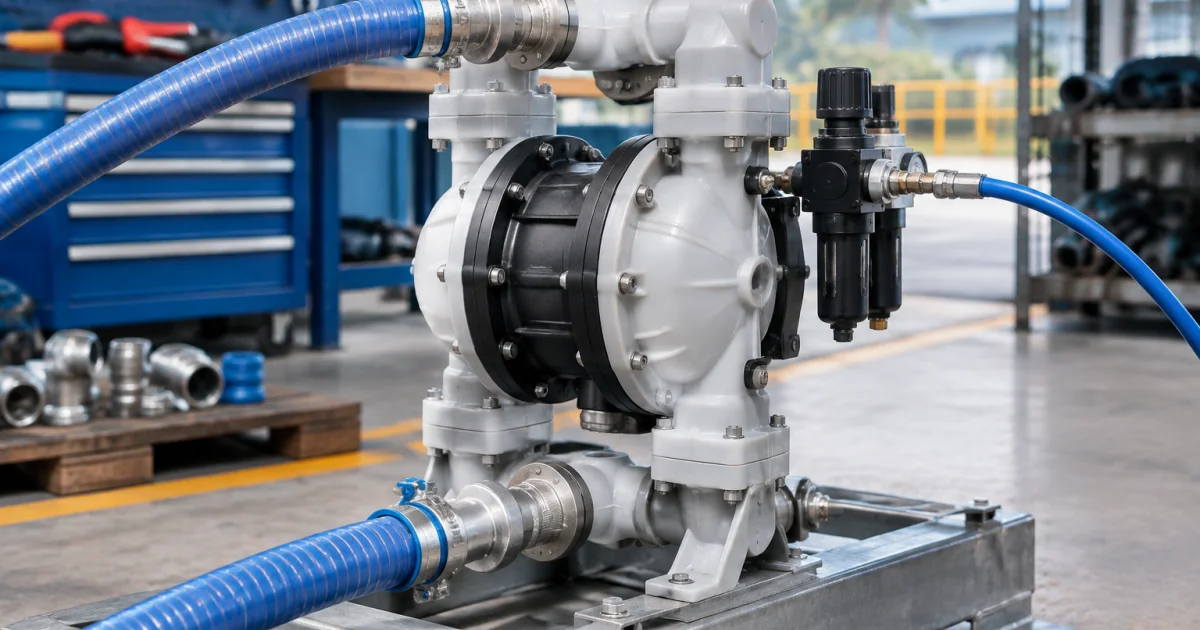
For maintenance and procurement teams, a diaphragm pump purchase often starts with urgency: a transfer line is down, a tote needs decanting, or a sump is overflowing. The next step is usually an RFQ—but for air-operated diaphragm pumps (AODD) and DC diaphragm pumps, a “quick quote” can lead to mismatched offers, long clarifications, or a pump that cavitates, stalls, wears diaphragms quickly, or misses the required flow.
This guide is for buyers in Malaysia preparing RFQs for chemical transfer, slurry, and wastewater duties. It explains what to provide so suppliers can size correctly, how to specify materials (without guesswork), and how to catch common mis-sizing traps before they become downtime. If you’re searching Diaphragm Pump Malaysia, use the checklist below to create a quote package that’s technically complete and easy to compare.
1) Start with the application: what “problem” is the pump solving?
Diaphragm pumps are popular because they can handle many liquids, tolerate intermittent dry running, self-prime in many setups, and pass some solids (depending on design). But “chemical pump” or “slurry pump” is not enough for correct selection. In your RFQ, describe the duty in operational terms:
- Process objective: transfer, dosing, circulation, IBC/drum unloading, sump dewatering, filter press feed, wastewater bypass.
- Location: indoor/outdoor, bunded area, corrosive atmosphere, confined space, or mobile trolley/skid.
- Operating pattern: 24/7, shift-based, batch transfer, intermittent short runs, emergency-only.
- Current pain point: leakage, seal failure, priming issues, clogging, air consumption, inconsistent flow.
Example: “Transfer spent caustic from a collection sump to a neutralization tank; pump is on a skid 3 m away, starts 6–10 times per shift, must tolerate occasional debris.” This immediately informs suction reality, materials risk, and whether AODD or DC is more practical.
2) The minimum technical data to include in every RFQ
Mis-sizing usually comes from hidden assumptions. Provide the items below. If you don’t know something, write “unknown” and share what you can measure (pipe size, approximate run length, photos/sketch).
2.1 Required flow rate (normal and peak)
- Normal flow: what the process needs to run steadily.
- Peak flow: short-term max (often driven by “empty a tote in X minutes”).
- Flow control method: on/off, throttling valve, regulator, pulsation damper, or speed control (DC).
Example: “Target 80–120 L/min; acceptable down to 60 L/min; prefer ability to throttle without damaging the pump.”
2.2 Total discharge pressure / head (not just “distance”)
Pressure requirement drives air demand and achievable flow. Specify:
- Discharge destination: open tank, pressurized vessel, header, filter press, nozzles.
- Static head: height difference between suction liquid level and discharge point.
- Line losses: approximate pipe/hose length and size, number of elbows/valves, hose vs hard piping.
- Backpressure variability: shared headers, switching valves, filter cycles.
If you can’t calculate total head, provide a simple sketch plus pipe/hose sizes and approximate lengths. A frequent RFQ error is underestimating friction loss in long, small-diameter hoses.
2.3 Suction conditions: flooded vs lift (where real installations differ)
AODD pumps are often called self-priming, but suction setup still controls reliability and achievable flow:
- Flooded suction: liquid level above pump inlet (most stable).
- Suction lift: pump above liquid level; state lift height and suction hose length/size.
- Supply container: IBC, drum, sump, tank; note strainer or foot valve.
- Viscosity and temperature: higher viscosity increases suction loss and reduces flow.
Common trap: a pump that can reach 100 L/min on flooded suction may struggle at the same flow with 4–5 m lift through a narrow hose. If lift is unavoidable, say so and request sizing for your actual suction conditions.
2.4 Fluid details: chemical name, concentration, solids, compatibility
Wetted material selection depends on the liquid. Include:
- Chemical / liquid name: include trade name and main component if known.
- Concentration range: e.g., 10–20%.
- Temperature range: normal and maximum.
- Specific gravity (SG): if unknown, state whether water-like or heavier.
- Solids: type (sand/fibrous/sludge), approximate size, and % if possible.
- Gas/air entrainment: foamy or aerated fluids can change performance.
If needed, share the Safety Data Sheet (SDS) under your internal procedure. The goal is to prevent incompatible materials and early failures.
2.5 Installation and interfaces: connections, utilities, constraints
- Port size and connection standard: threaded/flanged/hose tail; specify size (e.g., 1″ or 2″).
- Mounting: skid, wall bracket, trolley, tote frame.
- Utilities: AODD: available air pressure and practical supply; DC: voltage, duty cycle, control method.
- Environment: outdoor exposure, washdown, corrosive vapours, hazardous area/site constraints (state your requirement).
3) Choosing between AODD and DC diaphragm pumps for your RFQ
State whether you want AODD, DC, or for the supplier to propose both with reasons. This affects installed cost, running cost, and control.
3.1 When an air-operated diaphragm pump is a better fit
- Reliable compressed air is available and maintained (drying/filtration).
- Stall-safe behavior: can stall against closed discharge without motor overheating (depending on setup).
- Harsh/variable fluids: commonly used for corrosives, abrasives, and intermittent dry-run risk.
- Simple control: regulate with air pressure and a valve.
Include air quality concerns if relevant. Wet/dirty air can cause icing, erratic cycling, and faster valve wear; ask for recommended filtration/regulation.
3.2 When a DC diaphragm pump is a better fit
- Mobile or remote work where compressed air isn’t practical.
- Lower flow, controlled transfer: sampling, small transfers, light-duty dosing/maintenance.
- Noise/energy constraints: electric may be simpler than operating a compressor for intermittent needs.
If requesting DC, specify voltage (e.g., 12 V/24 V), chemical resistance requirements, and expected daily run time (some DC pumps are intermittent-duty, not continuous industrial service).
4) Material specification: how to request the right wetted parts
Quotes become non-comparable when materials are assumed. Two “diaphragm pumps” may differ in body material, diaphragms, balls/seats, and seals—changing compatibility and service life.
4.1 The key wetted components to specify
- Pump body / manifolds: common options include PP, PVDF, aluminium, stainless steel (depends on model/size).
- Diaphragms: PTFE-faced, Santoprene, nitrile, EPDM, etc.
- Check balls and seats: important for sealing and abrasion resistance.
- O-rings and gaskets: often overlooked but critical for chemical resistance.
Ask suppliers to list wetted materials clearly in the quotation line item (not only in a brochure). This enables faster technical evaluation.
4.2 How to request materials without over-committing
- Corrosive chemicals: request chemical-resistant plastics or stainless options; require confirmation against your chemical and concentration.
- Solvent-like fluids: request confirmation of elastomer suitability and permeation considerations.
- Slurry/wastewater: request abrasion-tolerant check valve configuration and maximum solids passage.
If unsure, request two material sets to compare risk vs cost (e.g., “Option A: PP body + PTFE diaphragm; Option B: PVDF body + PTFE diaphragm”).
4.3 Non-wetted constraints that still matter
- External corrosion: fumes can attack fasteners and air-side components.
- Temperature extremes: can harden elastomers and reduce priming/check sealing.
- Cleanliness requirements: for sensitive areas, state internal standards and cleaning expectations.
5) Sizing: the most common ways diaphragm pumps get mis-specified
Many problems are not simply “too big” or “too small,” but a mismatch between quote assumptions and real conditions.
5.1 Oversizing: higher operating impact and faster wear
- Higher air consumption at high cycling rates.
- Excess pulsation that stresses hoses/fittings and affects instruments.
- More aggressive check valve action that accelerates ball/seat wear.
What to request: expected flow at your stated discharge pressure and your available air pressure (AODD). If the pump greatly exceeds your needs, ask for a smaller size or a control approach (regulator + damper) and compare total operating impact.
5.2 Undersizing: “works on paper” but fails on site
- Failure to prime under real lift and suction line constraints.
- Flow collapse when backpressure rises (filters, longer routing, shared headers).
- Stalling when solids prevent check valves from sealing.
What to do: include a worst-case condition in the RFQ (max backpressure during a cycle, max solids size, longest hose routing). If you don’t state worst case, suppliers may size for best case.
5.3 Ignoring air supply limits (AODD-specific)
AODD performance depends on air pressure and air flow at the point of use. Prevent disputes by stating:
- Available air pressure at point-of-use (not compressor rating).
- Air line size and approximate distance from the drop to the pump.
- Shared header reality during production peaks.
If air flow capacity is unknown, ask the supplier to recommend an air preparation set and minimum air hose/pipe size for your target duty point.
5.4 Overlooking viscosity and shear sensitivity
Some slurries and polymer solutions are shear-sensitive. A diaphragm pump can be relatively gentle, but cycling rate and check valve action still matter. If shear sensitivity is a concern, state it and ask for a recommended operating range and whether a larger pump running slower is preferred.
6) How to structure a quote request so bids are comparable
A clear RFQ forces “apples-to-apples” offers and reduces clarification loops. Use the structure below in your procurement template.
6.1 RFQ template (copy/paste)
Project / Area: [Plant / line / location]
Duty: Transfer / dosing / unloading / sump, including operating pattern.
Liquid: [Name], concentration [x%], temperature [x–y°C], SG [x], viscosity [approx], solids [type, %], max particle size [x mm], aerated/foamy [yes/no].
Flow requirement: Normal [x L/min], peak [y L/min], transfer time target [if applicable].
Discharge condition: Destination [open/pressurized], estimated backpressure [x bar] or piping details [size, length, fittings].
Suction condition: Flooded / lift [x m], suction line [size/length], strainer/foot valve [yes/no].
Utilities: AODD: air pressure at point-of-use [x bar], air line size [x], air quality [dry/oily/unknown], shared header [yes/no]. DC: voltage [12/24V], duty cycle [intermittent/continuous], control [switch/PWM].
Materials required: Preferred body [PP/PVDF/SS/etc.], diaphragm [PTFE/EPDM/etc.], balls/seats [specify or request recommendation].
Connections: Inlet/outlet [size], type [threaded/flanged/hose tail].
Requested deliverables in quote: (1) pump model/size, (2) wetted materials list, (3) performance at stated conditions, (4) recommended air prep set/regulator, (5) recommended pulsation damper (if needed), (6) lead time/warranty (per your policy), (7) optional spares list (diaphragms, balls, seats).
6.2 What to ask suppliers to show (to avoid hidden assumptions)
- Performance at your duty point: flow at your discharge pressure and available air pressure (or DC voltage/control).
- Maximum solids passage and any limitations for fibrous solids.
- Air consumption guidance at the expected operating point (even qualitative).
- Noise considerations if installed near operators.
- Maintenance approach: typical wear items and whether service is kit-based or individual parts.
7) Practical examples: two RFQs that prevent mis-sizing
Use these as reference formats. They’re detailed because one wrong pump can cost far more than one thorough RFQ.
Example A: AODD for corrosive chemical transfer from IBC to process tank
- Duty: Unload IBC twice per day to an elevated process tank.
- Liquid: Corrosive chemical solution; SDS available; ambient temperature; no solids.
- Flow: Target 60–80 L/min; empty 1000 L in under 20 minutes.
- Discharge: 2″ hose, 15 m with elbows; discharge point 5 m above IBC outlet; destination tank vented.
- Suction: Flooded (IBC valve above pump inlet).
- Utilities: Air 6 bar at nearby drop; current air hose 1/2″; air quality dry.
- Request: Propose pump size and body/diaphragm materials; include recommended regulator/filter and pulsation control if needed.
Example B: Slurry/wastewater AODD for sump dewatering with solids
- Duty: Dewater wastewater sump; intermittent shift use; occasional emergency during heavy cleaning.
- Liquid: Wastewater with fine solids and occasional debris; solids up to ~5 mm; may be aerated/foamy.
- Flow: 150–250 L/min desired; throttling acceptable.
- Discharge: To plant drain header; backpressure varies with header load.
- Suction: Lift ~2.5 m; suction hose 3 m with strainer; pump above sump.
- Utilities: Air 5.5–6 bar but shared; prefer robust priming and anti-stall behavior.
- Request: Recommend check valve configuration/materials for solids; propose minimum suction hose size; advise whether a larger pump running slower is preferred.
8) Buying considerations beyond the pump: accessories, spares, and alternatives
The “pump only” price rarely reflects installed performance. Include key accessories and spares in evaluation so the system works from day one.
8.1 Accessories that often prevent early failure
- Air preparation (AODD): filter + regulator (lubricator only if required by your setup/model).
- Pulsation dampers: reduce shock loads on hoses/instruments; useful on long lines or sensitive processes.
- Correct hoses and couplings: undersized hoses are a common root cause of low flow.
- Strainers: protect check valves, but must be sized to avoid suction starvation.
8.2 Suggested spares for maintenance planning
Typical wear parts include diaphragms, check balls, seats, and O-rings. Ask for an optional recommended spares kit for one maintenance cycle; even if not purchased immediately, it clarifies lifecycle cost and lead-time risk.
8.3 When a different pump type might be better
- Clean water at steady flow: centrifugal pumps can be simpler and more energy-efficient for continuous duty.
- Higher head clean-water duties: end-suction or multistage centrifugal options may be better.
- Firewater/emergency compliance: dedicated fire fighting pump sets are engineered for that duty.
If your RFQ shows you’re moving mostly clean water at stable conditions, ask suppliers to confirm whether a standard industrial water pump is more economical over time.
Conclusion: a quote that installs smoothly starts with a complete spec
The fastest way to get a reliable diaphragm pump is usually not to request more quotes—it’s to request better quotes. When you specify flow and pressure, suction conditions, fluid properties (including solids), utilities, and wetted materials, suppliers can size accurately and you can compare bids on equal terms. Use the RFQ template, attach a basic line sketch/photos, and request performance at your stated conditions to reduce clarification cycles and avoid downtime after installation.
Frequently Asked Questions
What information should I include when requesting a diaphragm pump quotation?
Include the duty (transfer/dosing/sump), required flow range, discharge pressure or piping details, suction condition (flooded or lift), fluid name and concentration, temperature, viscosity/SG, solids content and max particle size, utility details (air pressure/line size for AODD or voltage/duty cycle for DC), connection type/size, and preferred wetted materials. Also ask the supplier to confirm performance at your stated conditions and list wetted parts materials clearly in the quote.
How do I choose materials for a diaphragm pump handling chemicals?
Ask the supplier to specify the wetted materials for the body/manifolds, diaphragms, check balls/seats, and seals/O-rings, then confirm compatibility with your chemical, concentration range, and temperature. If you are unsure, request two material options (for example different body plastics or elastomer sets) and evaluate risk versus cost. Providing the SDS under your internal procedure can help prevent an incorrect material selection.
What causes diaphragm pumps to be mis-sized most often in real installations?
Common causes are missing discharge backpressure details, underestimating friction losses in long or undersized hoses, not stating suction lift and suction line limitations, ignoring viscosity or air entrainment, and assuming the plant air supply can deliver enough pressure and flow at the point of use. Stating worst-case conditions and sharing basic piping/hose sizes and distances reduces the chance of a pump that works on paper but fails on-site.
Do I need to specify my compressed air supply details for an air-operated diaphragm pump?
Yes. Provide available air pressure at the point of use (not just compressor rating), air line/hose size and approximate length, whether the header is shared with other equipment, and any known air quality issues (water/oil). AODD performance depends heavily on real air supply; incomplete air information is a frequent reason quoted performance does not match installation results.
When should I consider a centrifugal pump instead of a diaphragm pump?
If the liquid is clean or lightly contaminated water, the duty is steady and continuous, and you need efficient transfer at a stable operating point, a centrifugal pump may be simpler and more economical long term. For higher head clean-water duties, end-suction or multistage centrifugal designs are often considered. For firewater and emergency services, dedicated fire fighting pump systems are usually more appropriate than general-purpose transfer pumps.
Request a diaphragm pump quote with the right spec—Thong Fatt Jaya can help
Thong Fatt Jaya supports maintenance and procurement teams with application-based selection for air-operated and DC diaphragm pumps—especially for chemical transfer, slurry, and wastewater duties. If you share your flow/pressure target, suction setup, fluid details, and preferred materials, we can help you shortlist a suitable configuration and prepare a clearer, more comparable quotation.
Need help turning a site sketch and process notes into an RFQ-ready specification? Talk to our team for practical guidance on sizing, wetted materials, and recommended accessories such as air preparation sets, hoses, and spares.